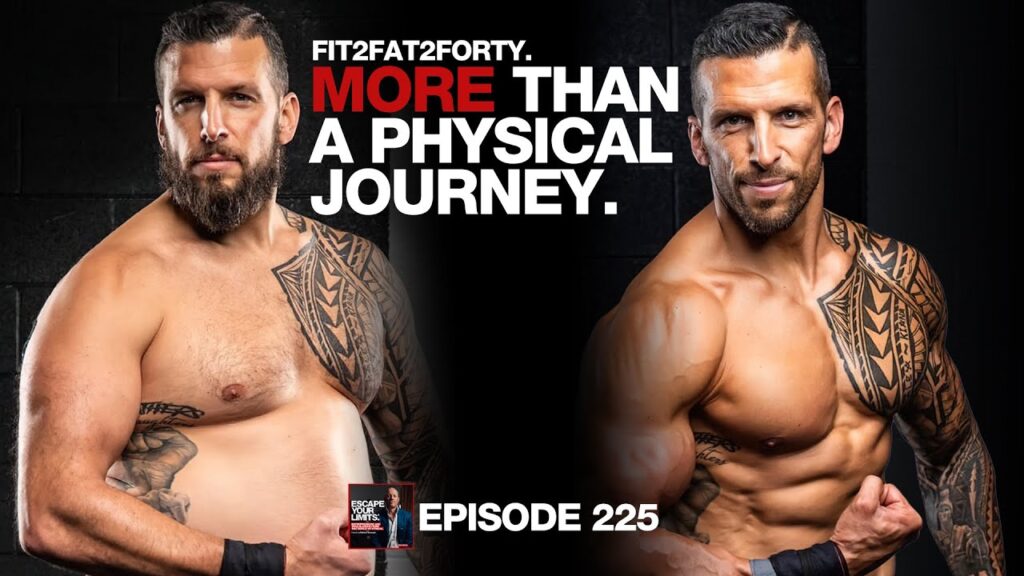
In this episode of Escape Your Limits, Matthew Januszek sits down with Drew Manning — a personal trainer who did something almost no one in the fitness industry has done: he deliberately gained weight and then lost it again, not for publicity, but to understand what his clients were actually going through.
The result was the bestselling book Fit2Fat2Fit and a perspective on health behavior that most fitness professionals never develop, because most of them have never experienced the struggle from the inside.
About Drew Manning
Drew Manning built his name on a willingness to go first. As a health and fitness expert and personal trainer, he recognized something uncomfortable: that trainers who have always been fit often have limited empathy for clients who find healthy habits genuinely difficult to build and sustain. His response was to run a real-world experiment on himself.
He purposefully gained a significant amount of weight and then worked to lose it — documenting the entire physical, mental, and emotional experience in his bestselling book Fit2Fat2Fit. The book doesn't just chronicle body composition changes; it tracks the psychological terrain of the process, including the moments of shame, frustration, and self-doubt that his clients had been describing to him for years.
What Manning found was not just empathy but a set of practical, tested insights about what actually works when the struggle is real. The experiment changed how he coaches, how he communicates, and what he believes about the relationship between trainers and the people who trust them.
What Drew Manning and Matthew Januszek Talked About
- Manning's experiment was first and foremost an act of professional humility — a recognition that understanding struggle from the outside is fundamentally different from experiencing it, and that the gap between those two positions limits a trainer's effectiveness.
- The physical impact of deliberate weight gain went beyond what Manning expected, and the recovery wasn't simply a matter of returning to old habits — it required confronting the behavioral and emotional patterns that make sustainable change hard for everyone, not just deconditioned clients.
- The mental and emotional dimensions of the experiment were more significant than the physical ones: Manning discovered that the psychological weight of feeling out of shape affected his confidence, motivation, and social behavior in ways that mirrored what his clients had been telling him for years.
- Tried-and-tested training methods that work for highly motivated, already-fit people often fail for people in early stages of behavior change — Manning's experience gave him a more nuanced, graduated approach to programming that meets people where they actually are.
- Empathy is a coaching superpower that can't be faked — clients who are struggling can detect whether a trainer has genuine understanding of their experience, and that detection shapes how much they trust the process and stay committed through setbacks.
- Unexpected life lessons from the experiment included a reckoning with identity: Manning's sense of self had been deeply tied to his fitness level, and losing that temporarily revealed how fragile identity-based motivation is compared to values-based motivation.
- The experiment changed how Manning communicates with clients about habit formation — he now approaches healthy lifestyle change as a gradual, compassionate process rather than a binary transformation, which produces better long-term outcomes.
Why This Conversation Matters
The fitness industry has a persistent blind spot around the lived experience of people who find it hard. Most of the media, most of the marketing, and most of the coaching culture is built by people for whom fitness came naturally or early — and that shapes what gets built, what gets promoted, and who gets served well. Drew Manning's story is a corrective to that.
Matthew Januszek's work with Escape Fitness USA and the LIFTS Podcast is about building a better fitness world — and that requires taking seriously the people the industry has historically underserved. Manning's willingness to investigate his own assumptions is the kind of intellectual honesty that moves the conversation forward in ways that matter.
▶ Watch the full episode on YouTube
Related Episodes & Interviews
About Matthew Januszek
Matthew Januszek is the co-founder of Escape Fitness, the functional-training equipment brand he built from a UK startup into a global name supplying many of the world’s leading gyms, studios, and hotel fitness spaces. Following the separation of the UK and US businesses, Matthew’s focus today is Escape Fitness USA and the next chapter of the brand in North America. He hosted more than 300 episodes of the Escape Your Limits podcast and now co-hosts the LIFTS Podcast with SweatWorks founder Mohammed Iqbal, covering the business, science, and technology shaping the fitness industry. Explore more interviews and episodes on MatthewJanuszek.com.
About The Author

Originally published .