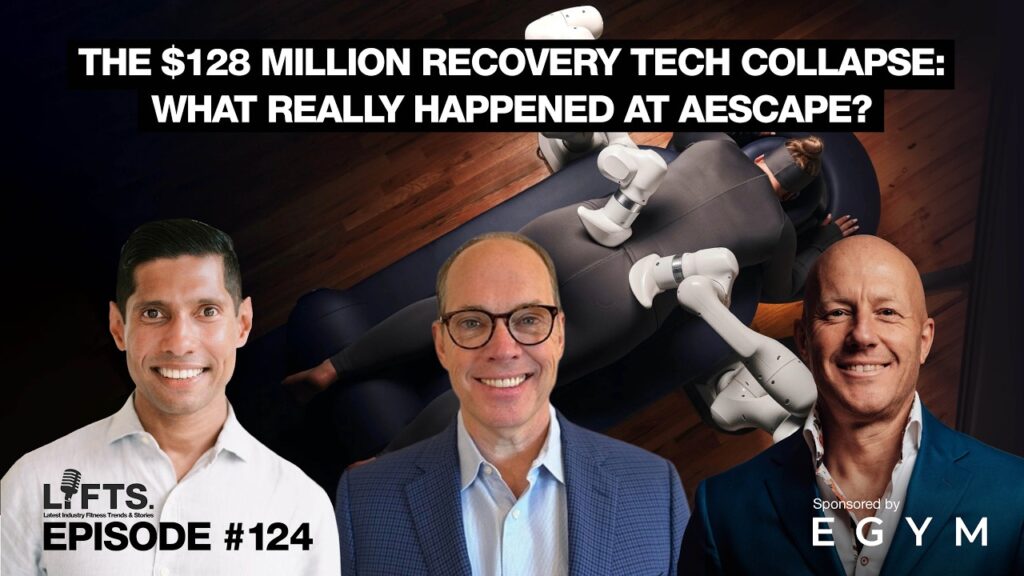
When Aescape entered insolvency proceedings following reports of a $128 million funding shortfall, it became one of the most-discussed stories in wellness technology in years. But according to Frank Britt, Aescape's CEO, the headlines missed the most important parts of the story. On this episode of LIFTS, Matthew Januszek and Mohammed Iqbal sit down with Britt to hear the full picture — what really happened, what the company learned, and how it is rebuilding.
LIFTS — Matthew and Mo's weekly fitness industry show at liftspodcast.com — was made for exactly this kind of conversation: rare, honest, and grounded in the operational realities that shape the businesses operators, investors, and founders actually have to run. The Aescape episode goes beyond the collapse to examine a much larger question: whether recovery robotics can move from high-profile novelty to mainstream fitness infrastructure, and what it would actually take to get there.
What This Episode Covers
Aescape built one of the most ambitious robotics platforms in the fitness and wellness industry — automated massage systems that found their way into partnerships with major fitness brands, hotel groups, and wellness operators. The company raised significant capital against the vision that automated, AI-driven bodywork could deliver consistent, personalized recovery at scale without the labor constraints that have long limited traditional massage therapy.
The collapse, as Frank Britt explains it, was not primarily a product failure — it was a business model failure. The 'robots as a service' approach that underpinned Aescape's commercial strategy proved economically unsustainable, creating a unit economics problem that capital alone could not solve. The restructuring that followed is built around a new model centered on product ownership, platform services, and a longer-term scalability thesis.
The broader context matters: Aescape's story is part of a pattern in frontier technology companies, where genuinely transformative products often go through a painful adoption cycle — from novelty and premium positioning to mainstream expectation — before the economics settle into something sustainable. Frank Britt's argument is that Aescape is still in that cycle, not at the end of it, and that recovery intelligence and personalized bodywork data represent one of the most important emerging layers in the future wellness stack.
Key Moments from the Conversation
- The 'robots as a service' business model was the core source of Aescape's financial difficulty — not the technology itself — and understanding the distinction matters for everyone evaluating frontier wellness businesses.
- Aescape's restructuring is built around ownership and platform services rather than recurring subscription access, a shift that changes the unit economics and the customer relationship in fundamental ways.
- Recovery is moving to the center of the consumer fitness and wellness experience, driven by labor shortages, the demand for personalization, and the growing evidence base for recovery's role in performance and longevity.
- Technology adoption in fitness follows a recognizable cycle — from novelty to premium feature to mainstream expectation — and Britt argues that recovery robotics is still in the early-to-middle stages of that journey, not at its end.
- The economics of recovery as a business category are changing rapidly, and operators who think of recovery as an amenity rather than infrastructure are likely to be caught flat-footed as consumer expectations shift.
- AI-driven recovery diagnostics and personalized bodywork data represent an emerging capability layer that could become as integral to fitness facilities as strength equipment or cardio machines are today.
- For operators, founders, and investors, the Aescape story is a case study in what happens when genuine innovation collides with the practical realities of scaling a hardware-dependent service business in a market that is not yet ready to absorb the price point.
- The future of recovery technology, as Britt sees it, is not diminished by what happened at Aescape — it is clarified by it: the path to scale runs through ownership, data, and integration with the broader wellness and longevity stack.
Why This Conversation Matters
The Aescape episode of LIFTS is valuable precisely because it refuses to flatten a complicated story into a simple failure narrative. Matthew Januszek and Mo Iqbal bring the perspective of people who understand what it takes to build hardware-based fitness businesses — and that context makes the conversation with Frank Britt richer and more honest than a standard post-mortem.
For anyone working in fitness technology, recovery, or wellness investment, this episode offers something genuinely rare: a firsthand account of where a frontier company went wrong, what it has learned, and why its leadership still believes the underlying opportunity is real. The LIFTS Podcast exists to surface exactly these kinds of stories — the ones the industry needs to hear, not just the ones that are easy to tell.
▶ Watch the full episode on YouTube
Related Episodes & Interviews
About Matthew Januszek
Matthew Januszek is the co-founder of Escape Fitness, the functional-training equipment brand he built from a UK startup into a global name supplying many of the world’s leading gyms, studios, and hotel fitness spaces. Following the separation of the UK and US businesses, Matthew’s focus today is Escape Fitness USA and the next chapter of the brand in North America. He hosted more than 300 episodes of the Escape Your Limits podcast and now co-hosts the LIFTS Podcast with SweatWorks founder Mohammed Iqbal, covering the business, science, and technology shaping the fitness industry. Explore more interviews and episodes on MatthewJanuszek.com.
About The Author

Originally published .